Truth vs Myth: Local AI in Small Business
There's a version of AI that lives in the cloud, costs a fortune, and requires a dedicated IT team to keep running. That's the version most small business owners picture when someone says "AI for your business." And honestly? That hesitation makes complete sense.
But it's also completely outdated.
Local AI has changed. Fast. And the gap between what people think it is and what it actually is in 2025 is wider than ever.
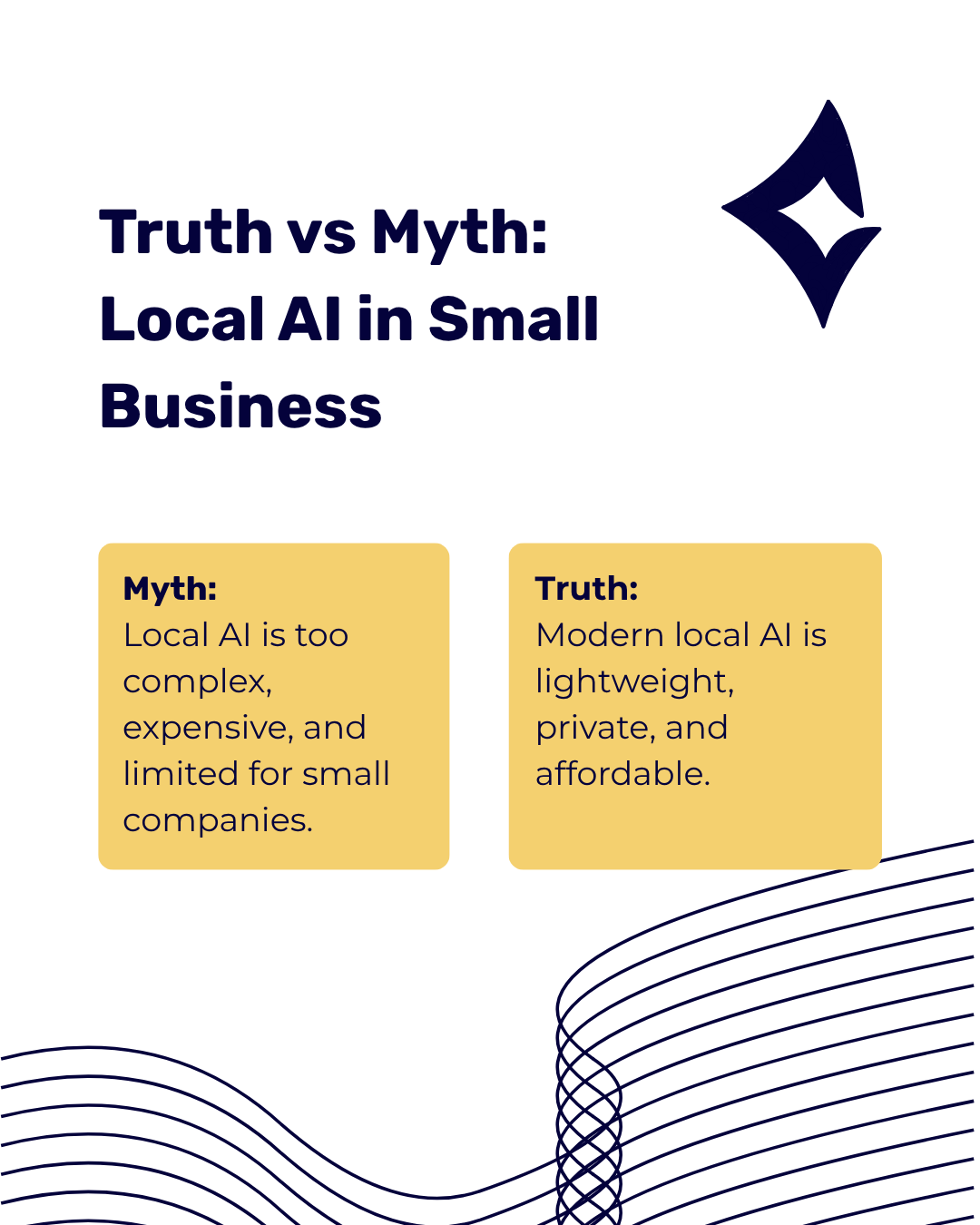
The Myth: Local AI Is Too Complex, Expensive, and Limited for Small Companies
This belief didn't come from nowhere. A few years ago, running AI on your own hardware meant serious technical infrastructure, significant upfront costs, and ongoing maintenance that required specialist knowledge. For a small business, that was a non-starter.
So the myth stuck. And for a lot of SME owners, it's still the default assumption — even though the reality has shifted completely.
The Truth: Modern Local AI Is Lightweight, Private, and Affordable
Today's local AI models are designed to run efficiently on standard business hardware. No server farm required. No cloud subscription draining your budget every month. No data leaving your building.
That last point matters more than people realise.
When you use cloud-based AI tools, your data — your client information, your internal documents, your business processes — travels to external servers. For many industries, that's a compliance issue. For all businesses, it's a risk you're taking every single time.
Local AI eliminates that risk entirely. Everything stays on your machine, within your network, under your control. It's GDPR-friendly by design, not by policy.
Why Local AI Is Particularly Well-Suited to SMEs
Large enterprises have cloud budgets, legal teams, and IT departments to manage the complexity of cloud AI. Small businesses don't — and shouldn't have to.
Local AI levels that playing field. Here's what it actually looks like in practice for a small business:
No ongoing API costs. You're not paying per query or per user. Once it's set up, it runs.
Data privacy by default. Sensitive client data, financial records, internal communications — none of it touches an external server.
Works offline. No internet dependency means no downtime, no latency, and no exposure during connectivity issues.
Tailored to your business. Local AI can be configured around your specific workflows, terminology, and processes — rather than a generic model trained on everything and optimised for nothing in particular.
The Biggest Misconception: That You Need to Choose Between Power and Privacy
Cloud AI tools are powerful — nobody's arguing otherwise. But the assumption that you have to sacrifice capability to keep your data private is no longer true.
Modern local AI models are closing the performance gap quickly. For the kinds of tasks that matter most to small businesses — document processing, internal search, workflow automation, summarisation, client communication drafts — local AI performs exceptionally well. Often better than a cloud tool, because it can be fine-tuned to your specific context.
You don't have to choose between a capable tool and one you can actually trust with your data.
Common Use Cases for Local AI in Small Business
Still feels abstract? Here's where SMEs are actually using local AI right now:
Document and contract analysis — surfacing key information from lengthy documents without sending them to an external platform.
Internal knowledge bases — letting your team ask questions and get answers from your own company documentation, instantly.
Meeting summaries and transcription — processing recordings locally, with full privacy, so nothing sensitive leaves the room.
Automated report drafting — pulling from internal data to generate first drafts of regular reports, without manual compilation.
Customer communication support — drafting responses based on your tone, your products, your policies — not a generic template.
What This Means for Your Business
The businesses that will pull ahead over the next few years aren't necessarily the ones with the biggest budgets. They're the ones that adopt the right tools early — tools that are practical, affordable, and built around how they actually operate.
Local AI is one of those tools. And for small businesses that handle sensitive data, work with clients who expect confidentiality, or simply want to automate intelligently without handing their operations over to a third-party platform — it's not just a good option. It's the smart one.
At Auda, we help small businesses implement local AI solutions that are practical, private, and built around your specific needs — not a one-size-fits-all platform.