
Why Micro-Automation Is the Smartest Move Small Businesses Can Make Right Now
Most small business owners didn't get into business to spend their afternoons re-entering data into spreadsheets, chasing invoices, or manually generating the same weekly report — again. And yet, here we are.
The good news? You don't need a €50,000 software project or an enterprise IT team to fix it. You just need the right small automation — applied in the right place.
That's the idea behind micro-automation: targeted, lightweight solutions that eliminate specific time-draining tasks — without disrupting the way your business already runs.
What Is Micro-Automation?
Micro-automation refers to small, focused automations that handle a single, repetitive task in your workflow. Unlike large-scale digital transformation projects that take months to implement and cost a fortune, micro-automations are fast to deploy, easy to manage, and immediately felt in your day-to-day operations.
Think of it like this: instead of renovating your entire office, you're installing a better lock on the front door — one small fix with a big daily impact.
For SMEs, this approach is a game-changer. You're not committing to a platform. You're not restructuring your team. You're solving one real problem — and then the next.
The Real Cost of Doing Things Manually
Let's put some numbers to it — because this is where it gets interesting.
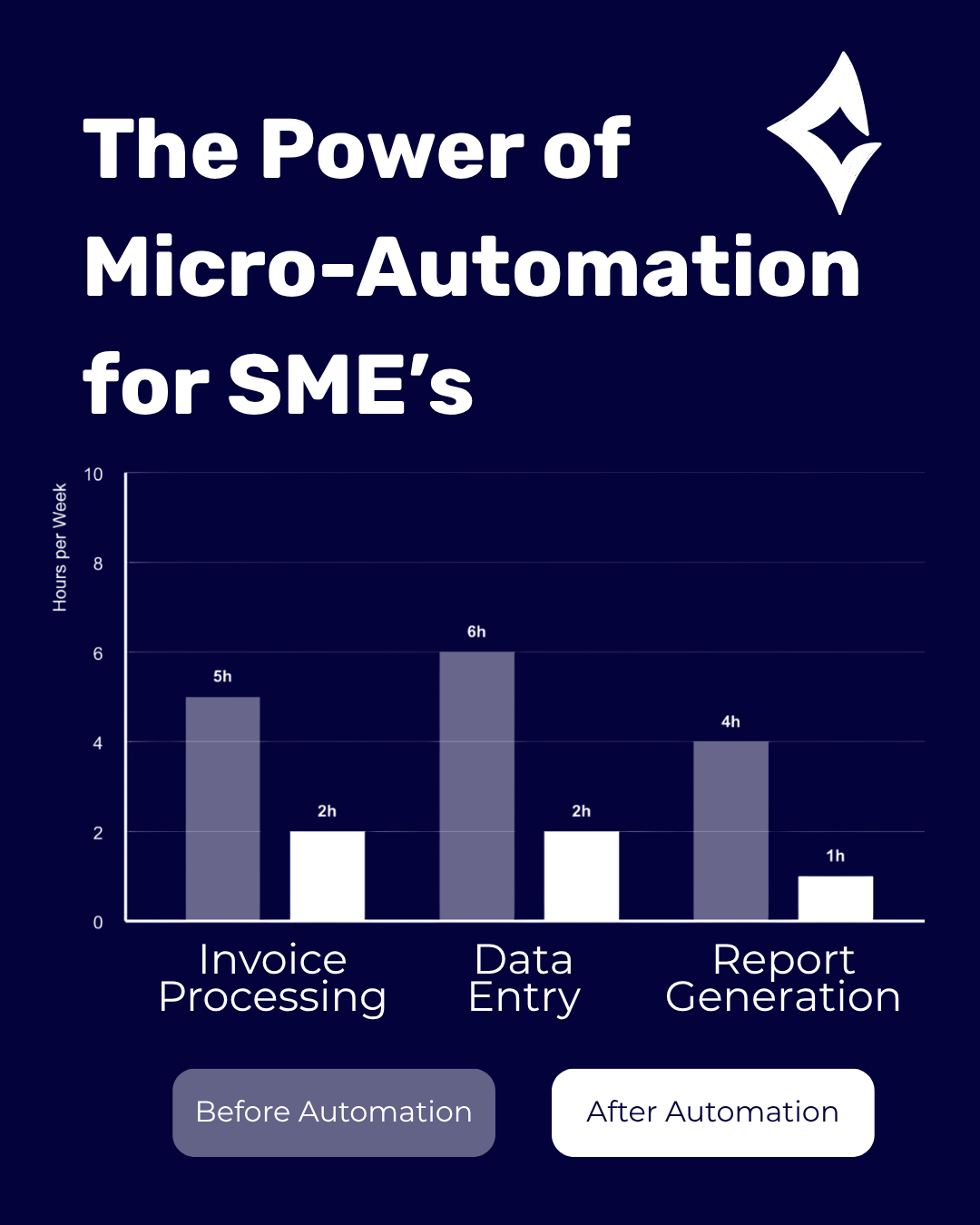
Three of the most common manual tasks in small businesses — invoice processing, data entry, and report generation — are quietly eating through your team's working week:
- Invoice Processing: 5 hours per week manually → 2 hours with automation (60% reduction)
- Data Entry: 6 hours per week manually → 2 hours with automation (67% reduction)
- Report Generation: 4 hours per week manually → 1 hour with automation (75% reduction)
That's 15 hours of manual work reduced to just 5 hours per week — across three tasks alone. For a team of five people, that's potentially hundreds of hours freed up every year. Hours that could go into client work, business development, or simply leaving on time.
This isn't hypothetical. These are real patterns we see across businesses every week — and they're fixable without a major project or a big budget.
Why Small Businesses Avoid Automation (And Why That's Changing)
Historically, automation has come with a catch. Either it's too expensive, too complex to implement, or built for companies 10 times your size with 10 times the IT support.
The common barriers we hear from SME owners:
"We don't have the technical resources to manage it." "Our processes are too specific — off-the-shelf tools won't work for us." "We tried something before and it created more problems than it solved."
These are all valid concerns — and they're exactly why the micro-automation approach exists. Instead of asking a business to overhaul how it operates, we identify one process that's costing you time, build a targeted solution around how you already work, and measure the result. Simple, fast, and low-risk.
Where Micro-Automation Has the Most Impact
Not every process is worth automating. The sweet spot is anything that's repetitive, rule-based, and time-consuming. Here's where we consistently see the biggest return:
Invoice and Document Processing Reading, categorising, and logging invoices is one of the most common time-sinks in small finance teams. Automating document intake — even partially — can eliminate the back-and-forth between inboxes and spreadsheets entirely.
Data Entry and Synchronisation If someone in your business is copying information from one system into another — a CRM, a spreadsheet, an ERP — that's an automation waiting to happen. Manual data entry isn't just slow, it's error-prone. A single automated sync can eliminate an entire class of mistakes.
Report Generation Weekly sales reports. Monthly dashboards. Project status updates. If the same person is spending the same hour every week pulling the same data from the same places — that's not analysis. That's data janitor work. Automate the gathering, and let your team do the thinking.
Client Onboarding and Follow-Up Flows Automated welcome sequences, document requests, and reminder flows keep the process moving without requiring manual nudges at every step. More professional for the client. Less exhausting for you.
Micro-Automation vs. Full-Scale Digital Transformation: What's the Difference?
Full-scale digital transformation is a major undertaking: new systems, new processes, staff retraining, and months of implementation. It can absolutely be worth it — but for most SMEs, it's not the right starting point.
Micro-automation is different. It's additive, not disruptive. You keep your existing tools and workflows. You add a targeted solution that handles one painful task better. You see the result quickly. And if it works — you do the next one.
For small businesses, this is often a far more sensible path to meaningful efficiency than a big-bang transformation project that carries high risk and uncertain returns.
How to Know Which Process to Automate First
A simple exercise: ask everyone on your team to write down the one task they do most often that they wish they didn't have to do. The answers will cluster quickly — and that cluster is your starting point.
Look for tasks that are done more than once a week, follow the same steps every time, don't require creative judgment, and involve moving data from one place to another. If it ticks those boxes, it's a candidate.
And the fastest way to go from "this is frustrating" to "this is fixed" is to start there — not with a big strategy document, but with one process and a solution built around it.
The Auda Approach: Automation That Fits Your Business — Not the Other Way Around
At Auda, we built our entire service philosophy around one idea: small businesses deserve the same automation capabilities as large corporations — without the enterprise price tag, the lengthy implementation, or the need to change how you work.
We don't sell platforms. We don't push you into subscriptions for features you'll never use. We look at your specific operations, identify the processes where automation creates real value, and build targeted solutions that integrate into what you already have.
The result is measurable, immediate, and built to last.
Want to Know Which Process You Could Automate This Week?
We offer a free process audit — a quick, no-obligation conversation where we look at one area of your operations and tell you exactly what you could automate, how long it would take, and what the impact would be.